Mitochondria
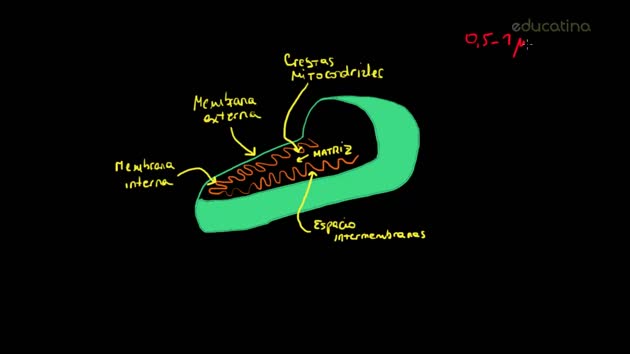
They comply with a primary function, are those responsible for obtaining the energy that the cell needs to fulfill all its functions, since all require the ATP - energy storage cells. They measure between 0.5 / 1 micron. Its quantity in each cell varies; Some only one or two have one or two, while others may have more than a thousand (you are ultimate are cells that are part of very active tissues such as liver tissue). They are covered by an external, porous, permeable membrane, by which proteins, minerals and liquids pass. It has an internal membrane, which is not as permeable, but rather selective; and between the previous one and this is a space called intermembrane or intermembranous, where there are proteins that pierced the outer membrane but which were rejected by the inner. In the interior of the inner membrane are the mitochondrial ridges, which are invaginations of that which They get inside the mitochondrial matrix. The latter is the central space that protects the membranes. The internal membrane has enzymatic complexes; which are involved in the process known as the electron transport chain. The latter is part of the process that allows cell breathing, by means of which the ATP or energy is obtained. In the matrix we find the mitochondrial DNA, which unlike nuclear DNA is circular, and contains the information for the synthesis of thirteen proteins ; That is, it has around thirteen genes that code information for thirteen proteins that will be used in the cell breathing process. Of course, mitochondria use much more than thirteen proteins, but the remaining ones come from the information coded in the core of the cell. It also contains ribosomes necessary for protein synthesis but in that case they are called mitoribosomes. In this process they use the mitochondrial RNA as an intermediary. As the exposed, we see that in the matrix there are all the necessary components to synthesize the proteins of the mitochondria. Simply as an information; We will mention that more than one hundred and fifty diseases are currently recognized that are origin in mitochondrial DNA mutations. Its failure is of great relevance given its function of generating energy for the functioning of the cell, it can cause neurodegenerative diseases.